
This Iowa Matchstick Museum Turns Patience Into Something Almost Impossible To Believe
It’s that kind of silence. The one that settles in when something is too good for words.
That’s exactly what you’ll find inside this place in Iowa. This museum sounds like a roadside curiosity. Then you walk in… and your brain needs a minute. Everything here is built from matchsticks.
Not small crafts, full-scale, insanely detailed structures like Hogwarts, the U.S. Capitol, even Cinderella’s Castle.
All glued together, one stick at a time. It started in 1977 as a hobby. Just 500 matchsticks and a tiny church. Now?
It’s the kind of work that makes assembling IKEA furniture feel like a personal failure. The artist eventually went all in.
And it shows. It’s quiet, unexpected, and genuinely mind-blowing.
Proof that sometimes the smallest materials create the biggest “wait… what?” moments.
The Origin Story That Started With 500 Sticks

Some of the greatest things in the world begin as simple weekend experiments. Back in 1977, a small creative spark led to a tiny country church made from just 500 wooden matchsticks.
So small it could fit inside a shoebox. At the time, it was nothing more than a quiet moment of curiosity, with no hint of what it might grow into.
Decades later, that modest beginning evolved into a lifelong pursuit. What started as a casual pastime became a full-time dedication, with creations expanding from a few hundred matchsticks to more than a million in a single piece.
Each work carries the quiet echo of that first experiment, a reminder of how something small can steadily transform into something extraordinary.
Over time, entirely new techniques emerged through patience and persistence. Individual matchsticks were carefully shaped into curves using precise tools, while thousands more were arranged into textured surfaces through a meticulous layering process.
These methods weren’t shortcuts, they were the result of years of exploration and refinement.
It all traces back to that first tiny structure. Knowing how it began makes every intricate creation feel more meaningful.
The humblest beginnings really can lead to the most remarkable outcomes.
A Tiny Iowa Town Hiding A World-Class Wonder
Gladbrook, Iowa is not exactly on most people’s travel bucket lists, and that is honestly part of the charm. Tucked into a quiet midwestern town, the Matchstick Marvels Museum at 319 2nd St, Gladbrook, IA 50635 is the kind of discovery that makes a road trip feel like a treasure hunt.
You round a corner in a small town and suddenly find yourself standing in front of a museum that has been featured by Ripley’s Believe It or Not on a global scale.
The museum is open daily from April 1 through November 30, running from 1 PM to 5 PM each day. Admission is just five dollars for adults and three dollars for children aged five through twelve.
For that price, you get access to around 20 large-scale matchstick masterpieces that took years each to create. It is genuinely one of the best deals in the entire state of Iowa.
The building is also handicap accessible and shares space with a community-run movie theater, which adds a wonderfully local touch to the whole visit.
Group tours can be arranged by appointment year-round, making it a fantastic option for school trips or organized outings. Visitors consistently mention being surprised by how much they enjoyed themselves.
That pleasant shock is exactly what makes stumbling onto this place in a small Iowa town feel like winning a little lottery you did not even know you entered.
Hogwarts Built Entirely From Matchsticks Is As Magical As It Sounds
If you grew up reading Harry Potter, walking up to this model is a full-on nostalgia moment. The Hogwarts School of Witchcraft and Wizardry model at Matchstick Marvels is built from over 600,000 individual wooden matchsticks.
Every turret, every archway, every stone-textured wall is made from tiny sticks glued together one at a time. It is the kind of thing that makes you feel like magic might actually be real after all.
What makes this piece especially remarkable is the scale and the patience it demanded. The creator did not rush this project.
He studied the architecture, planned every section, and executed it with the kind of focus that most people reserve for maybe one or two moments in their entire lives. The result is a model that feels alive with detail, the sort of thing you circle multiple times because there is always something new to notice.
Fans of the franchise will find themselves leaning in close to spot familiar towers and corridors. Even visitors who have never read a single page of the series tend to stop and stare.
There is something universally awe-inspiring about seeing a fictional world rendered in such an unexpected medium. This model alone is worth the trip to Gladbrook.
It sits as a reminder that creativity has no boundaries, and sometimes a box of matchsticks is all the magic wand you actually need.
Cinderella’s Castle Made From 607,000 Matchsticks Is Pure Fairy Tale Fuel
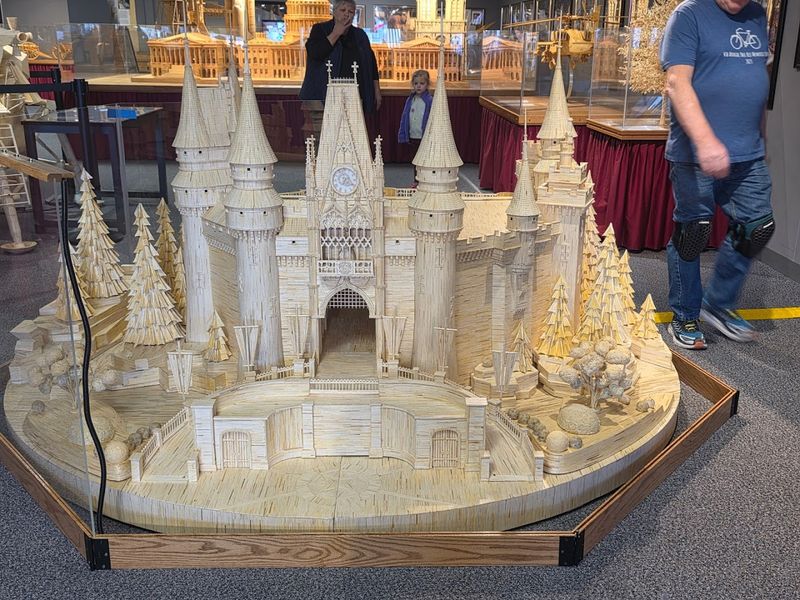
Standing nine feet tall and built from 607,000 matchsticks, the Cinderella Castle model is the kind of thing that stops you mid-step. It took two full years to complete, and it is now a permanent fixture at the Matchstick Marvels Museum.
The moment you see it in person, you understand why this piece earned its permanent status. Nothing about it feels temporary or small.
The detail work on this model is genuinely hard to process at first. The spires, the arched windows, the textured walls, everything is made from those same humble wooden sticks you might find in a kitchen drawer.
Creator used his sheet-building technique extensively here, layering thousands of matchsticks onto Plexiglas to create the smooth facades of the castle walls. The result is a structure that somehow manages to look both rustic and regal at the same time.
There is a fun emotional layer to seeing this model. Cinderella’s Castle is one of the most recognizable structures on the planet.
Millions of people have photos in front of the real thing at Disney World.
Seeing it recreated in matchsticks in a small Iowa museum flips your sense of scale completely upside down. It makes you think about how big things can be broken into tiny pieces, and how tiny pieces can build something enormous and breathtaking.
That is honestly a pretty powerful idea wrapped inside a very beautiful display.
The U.S. Capitol And Notre Dame Show History Has Never Looked This Tiny
History class never looked this good. The U.S.
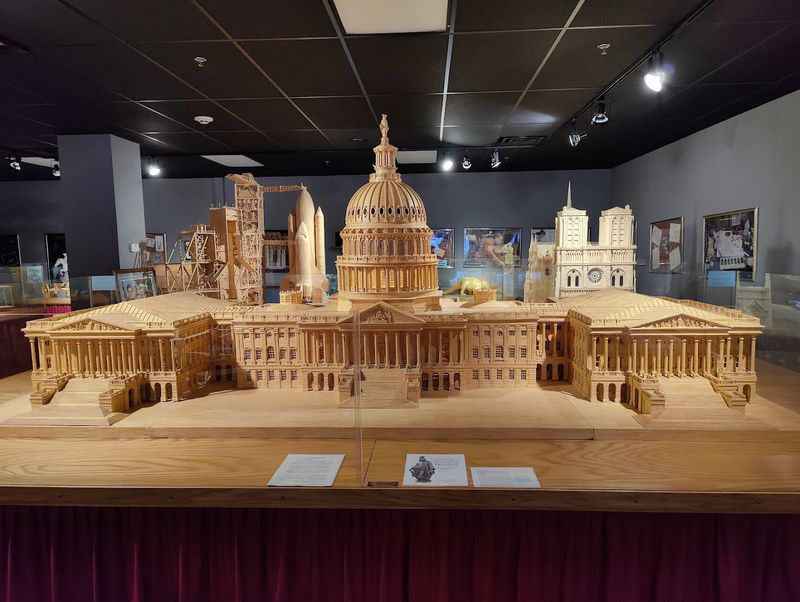
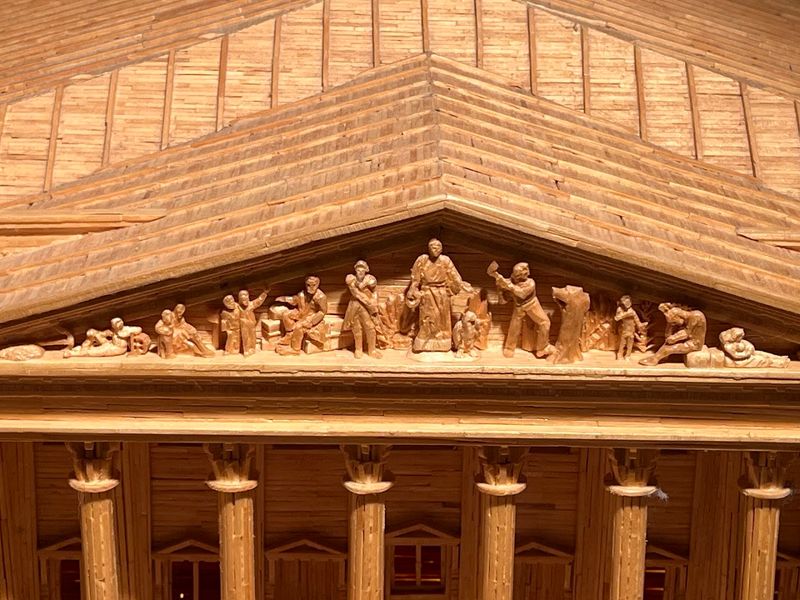
Capitol model stretches 12 feet long and stands 5.5 feet tall, assembled from nearly 500,000 matchsticks.
Every column, every dome detail, every wing of the building is represented with a level of accuracy that feels almost architectural. Walking the length of this model is like doing a slow tour of one of America’s most iconic landmarks, just at a fraction of the size.
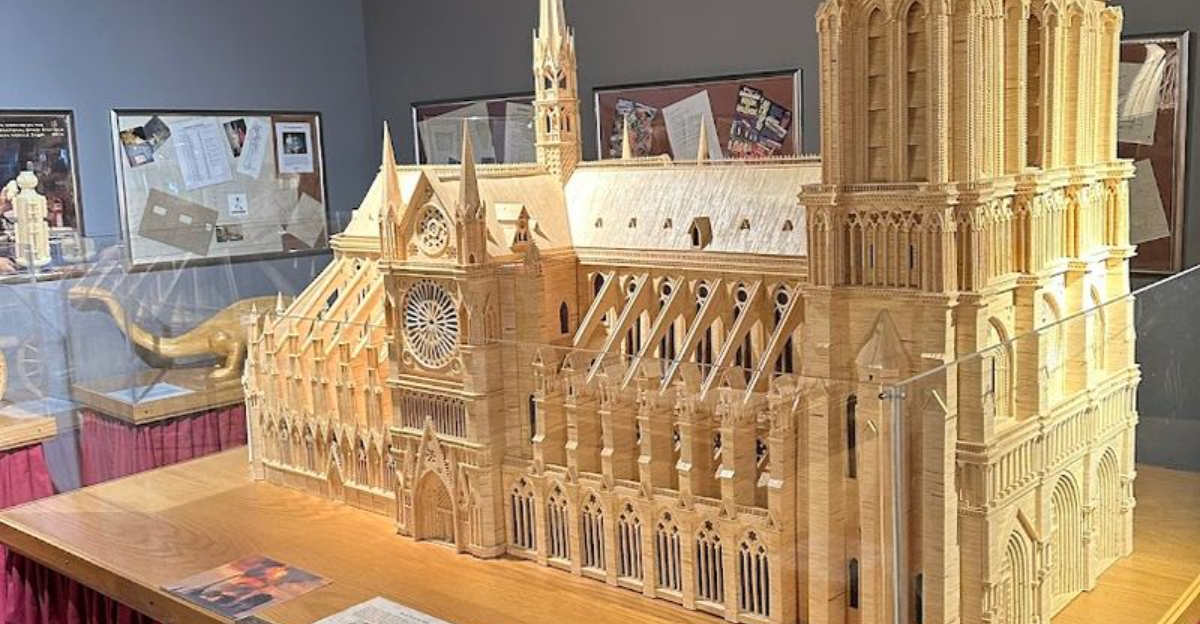
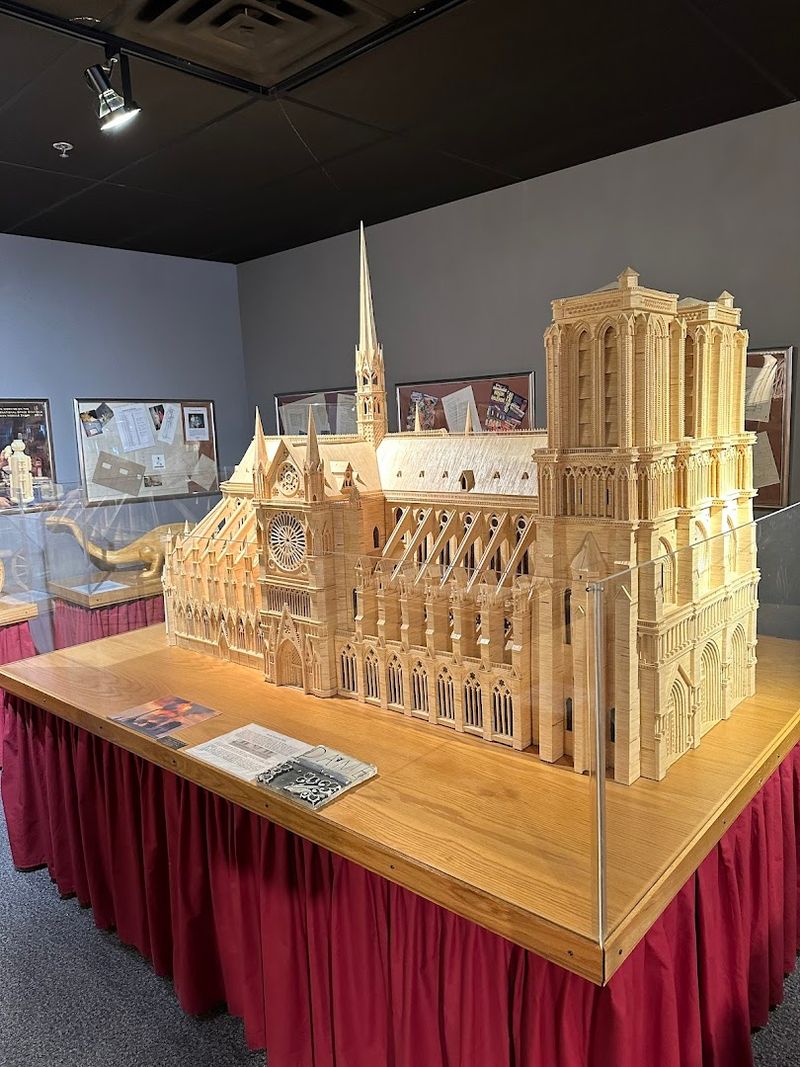
Right alongside it, the Notre Dame Cathedral model brings a piece of Paris to the Iowa prairie. Completed in 2012 and built with nearly 300,000 matchsticks, the cathedral stands over seven feet long.
The flying buttresses, the rose windows, the iconic twin towers, all of it is there in matchstick form. Given Notre Dame’s real-world fire in 2019, this model carries an extra layer of emotional weight that visitors often feel without expecting to.
Seeing these two structures side by side in the museum creates a fascinating conversation between history and art. One represents American democracy, the other represents centuries of European heritage.
Both are rendered in the same humble material, which creates this wonderful sense of equality between two very different monuments.
These models do not just impress. They make you think.
Plane Loco And The Saturn V Rocket Prove Imagination Has No Ceiling

Ripley’s Believe It or Not commissioned a model so wild that it deserves its own chapter. Called Plane Loco, this steampunk flying locomotive is largest creation.
It required over one million matchsticks and was completed in 2015. The concept alone sounds like something dreamed up at 2 AM, and the finished piece looks exactly that wonderfully unhinged.
It is the crown jewel of ambition in a museum already packed with ambitious work.
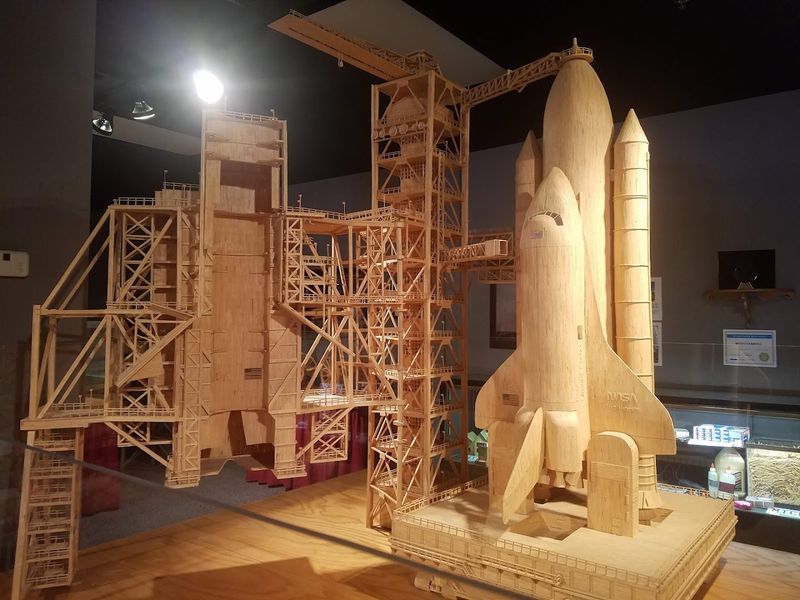
Then there is the Saturn V Rocket, completed in 2020 using 241,000 matchsticks. This one is interactive, featuring actual lights built into the model.
Seeing a lit-up rocket made entirely of matchsticks in a small Iowa museum is the kind of surreal experience that you describe to friends and watch their faces slowly shift from skeptical to completely fascinated. Space exploration and matchstick art are not two things you expect to meet, and yet here they are.
Both of these models represent different ends of the creative spectrum. Plane Loco is pure imagination, a thing that could never exist in the real world, given matchstick form.
The Saturn V honors real human achievement, the actual rocket that carried astronauts to the moon.
Why Matchstick Marvels Is The Unexpected Highlight
Road trips have a way of delivering the best surprises when you least expect them. Sometimes, a quiet stop turns into something far more memorable than planned.
An experience that leaves a lasting sense of wonder rather than just a passing impression. Places like this don’t rely on grand scale or high prices, but on the ability to genuinely captivate.
Beyond the main displays, there’s a deeper layer to explore. Original drawings, planning sketches, and tools reveal the thought and precision behind each creation.
A short film plays on a loop, offering insight into the creative journey and adding context to everything in the room. Understanding how each piece came to life makes the experience feel more personal than a typical museum visit.
Around twenty large-scale models fill the space at any given time, with some traveling to exhibitions around the world. Those that remain feel like quiet treasures, each representing years of focused, disciplined, and joyful work.
There’s a calm, almost meditative energy in the space. Something difficult to describe, yet immediately felt.
If you ever find yourself passing through Iowa, it’s the kind of stop that stays with you long after the journey continues.