
This Ohio Mushroom House Makes Fantasy Feel Real
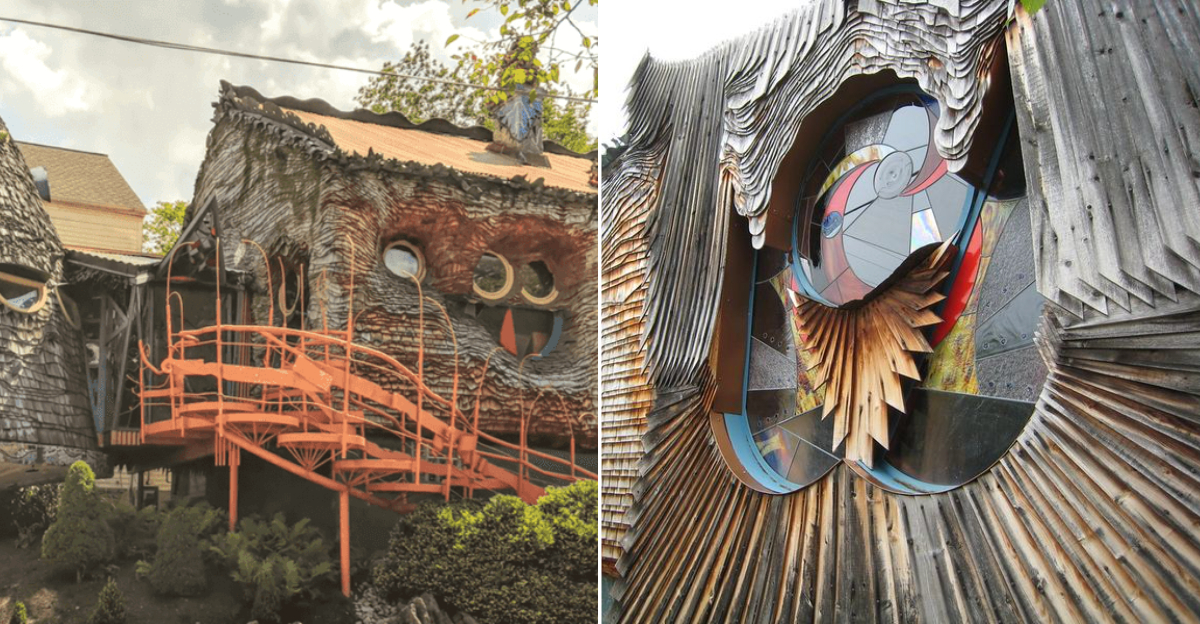
I’ll admit: when I first drove past this house, I rubbed my eyes. Here in leafy Hyde Park it stands, a mushroom sprung from suburban soil. The cedar shingles ripple like gills under shifting light, windows peer out like curious eyes, and a glass sunroom juts with whimsy.
It’s less a home and more a story you can walk around. Built over more than a decade by a visionary architect, it’s part sculpture, part dwelling, all curiosity.
Below are the details I poked around, in case you want to visit (and see what mushroom dreams look like in Ohio).
Location and Accessibility
Nestled on 3331 Erie Avenue, right where Erie meets Tarpis in Hyde Park, the Mushroom House announces itself quietly from the sidewalk. You won’t see gates or big signs, it’s tucked among familiar streets.
Passersby often slow, eyes telescoping to take in curved roofs and portholes among trees. The address is public, lots of guides list it as a quirky must-see.
Shoot photos from the sidewalk only, and bring a wide lens. You’ll want to capture its curves without trespassing.
The Long Build
It didn’t spring up overnight. Construction stretched from 1992 to 2006, as architect Terry Brown refined every curve with students, metalworkers, and collaborators.
The house evolved by layers: new ideas, adjustments, experiments. Brown kept tinkering until it felt right, morphing the design over time.
Knowing that, I saw the home not as fixed, but fluid. The fact that it took so long to reach “finished” gives you permission to explore every nuance, to walk slowly and wonder.
Compact Living
Don’t expect a mansion, this is a compact one-bedroom “studio house,” but what it lacks in square footage it makes up for in personality.
The design includes a cone-shaped addition and breezeway, each surface curving gently rather than striking straight lines.
My favorite trick: it feels larger than it is. Because your eye never stops dancing across curves and surprises, the space inside seems to breathe beyond its walls.
Stairs Like Sculpture
You’ll spot a bright orange spiral staircase rising like a stem, linking two volumes with a small bridge overhead.
That spiral is not just functional, it’s an object you want to walk around, look under, photograph from below. It’s sculpture in service of movement.
Let your eye follow it upward; it teases you to climb (or imagine what upstairs might feel like). Every twist reveals a new panorama of shapes.
Gills-Inspired Shingles
The curving cedar shingles ripple across walls, meant to echo the delicate “gills” under a mushroom’s cap.
They’re hand-cut and undulating, creating shadows and textures that shift with the sun. The effect is organic.
Seeing that, I realized how much detail went into every inch. The house isn’t just whimsical, it’s tactile, a shell grown rather than built.
Playful Windows
Round windows dot the façade, and a glass sunroom punches cheerful apertures through the thick shell.
Those portholes feel like little eyes onto the world, letting in pinpricks of light, reflections, and glimpses of sky.
I watched the interior glow at dusk, those circular windows turned golden. It felt like the house was waking up to the evening.
Neighborhood Exploration
Pairing a visit to the Mushroom House with a stroll through Hyde Park offers a complete experience.
This leafy neighborhood is filled with charm, from local cafes to serene walking paths. A drive-by of the house followed by a coffee break captures the essence of Cincinnati’s relaxed lifestyle.
Hyde Park’s inviting environment complements the house’s creativity, offering a day of exploration and enjoyment.
Educational Legacy
The Mushroom House served as Terry Brown’s studio, becoming a hands-on lesson in craft for his students. This educational aspect adds depth to the house’s history.
Brown’s teaching methodology embraced imagination and creativity, with the house as a living example.
Students learned through innovation, making the house a testament to experiential education. It remains an inspiring symbol of creative teaching.
Organic Materials
Wood, copper, and glass curve, fold, and overlap, materials used less like building blocks than like brushstrokes.
Each reveals its texture: cedar peels, weathered metal, hearth-warm glass catching reflections. The assemblage feels grown, not erected.
Standing close, I touched the shingles (briefly, respectfully). The tactile surprise connected me to the builder’s hands, truth in material.
A Creative Legacy
Brown passed away in 2008, but the house remains a centerpiece of Cincinnati’s creative identity.
It continues under care from his friends and admirers, cherished for its experimental spirit.
For me, knowing this adds poignancy. The house was never just architecture, it was an expression of someone’s lifetime. Today, it carries memory, curiosity, and possibility forward.