
This Strange California Landmark Will Make You Stop And Take A Second Look
Stop scrolling. Seriously.
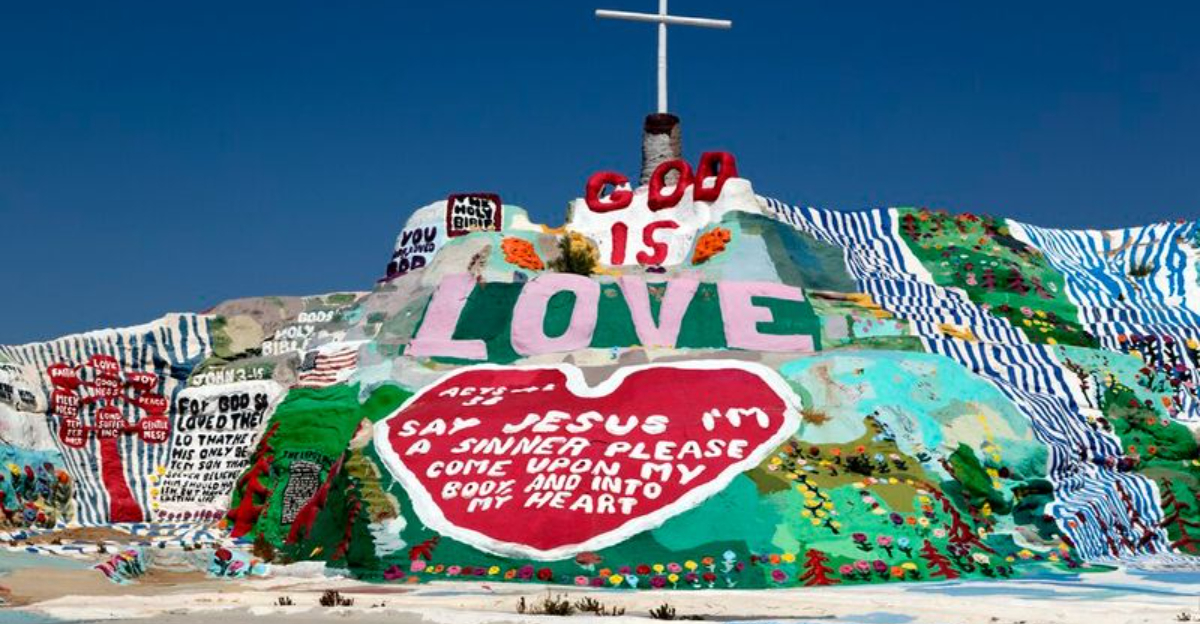
Because I just drove through the middle of the California desert and hit something so insane, so vibrantly impossible, that my brain did a double take. It’s huge. It’s colorful.
It doesn’t make sense. And somehow, it makes all the sense in the world.
Everywhere you look, bold letters scream one truth: God is love. And you don’t just read it.
You feel it. In the blazing sun, in the way the colors explode, in the weird, joyful chaos that only one human could build over decades. It’s quirky.
It’s spiritual. It’s a little bit absurd. And it doesn’t ask for your approval. It demands your attention.
This isn’t a roadside stop. This is a place that punches you in the heart… and leaves you smiling.
A Painted Desert Dream
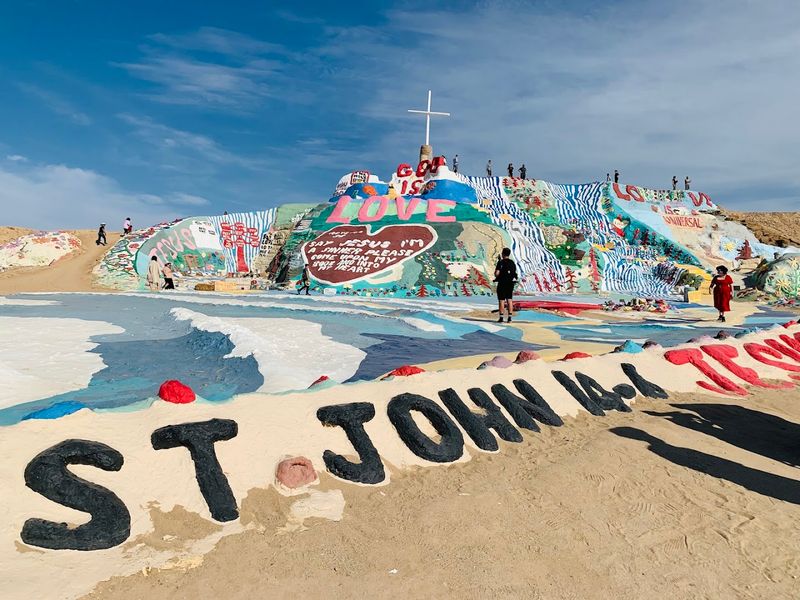
Standing at the base of Salvation Mountain for the first time felt like stumbling into a painting that had decided to become three-dimensional.
The sheer scale of the thing catches you completely off guard, because no photograph truly prepares you for how tall and wide and unapologetically colorful it actually is in person. Red, yellow, blue, and white paint cascade down the slopes in rivers and waves, punctuated by giant flowers and suns that look like they were drawn by the happiest artist who ever lived.
Leonard Knight started building this mountain in the late 1980s after an earlier hot air balloon project failed, and what began as a small mound eventually grew into a full-scale landmark recognized by the Library of Congress as a National Folk Art Treasure in 2002.
The base is made from adobe clay mixed with straw, painted layer after layer over the years until the colors became almost geological in their depth. Walking up the winding path to the top gives you a sense of the sheer human effort involved, because every step reveals new details, new messages, new bursts of color you did not notice from below.
From the summit, the Salton Sea glitters in the distance and the flat desert stretches endlessly in every direction, making the whole experience feel surreal and strangely peaceful.
Salvation Mountain does not ask anything of you except that you look and feel something real.
Getting There Is Half The Adventure
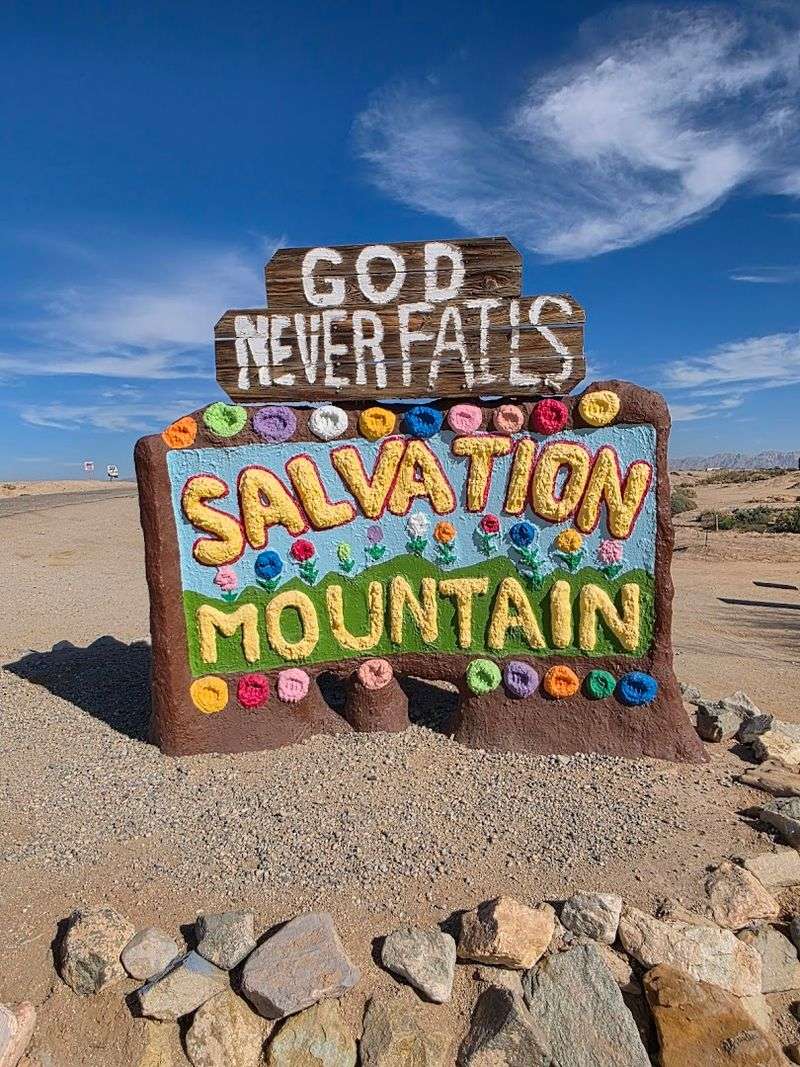
Getting to Salvation Mountain requires the kind of commitment that separates the curious from the truly adventurous. Located off Beal Road in Niland, California 92257, the site sits in the Imperial Valley near the southeastern shore of the Salton Sea, which means you are driving through some seriously remote, sun-baked desert to get there.
My GPS had a minor existential crisis somewhere around the last few miles, and I genuinely questioned whether I had made a wrong turn into another dimension.
The drive itself is part of the experience. Flat, pale desert stretches in every direction, dotted with scrubby vegetation and the occasional dust devil spinning lazily across the road.
Then, without any warning, a burst of color appears on the horizon like a mirage that refuses to disappear when you get closer. That first sighting from the road is genuinely one of the most memorable moments of any road trip I have ever taken, because your brain simply cannot process what it is seeing for a solid five seconds.
There is free parking right at the site, and admission is completely free as well, though donations are warmly accepted to help with ongoing preservation efforts. The best time to visit is early morning or late afternoon when the desert heat backs off a little and the light hits those painted slopes in the most extraordinary way.
Pack water, wear sunscreen, and bring a sense of wonder because you are going to need all three.
Where The Magic Gets Even Weirder
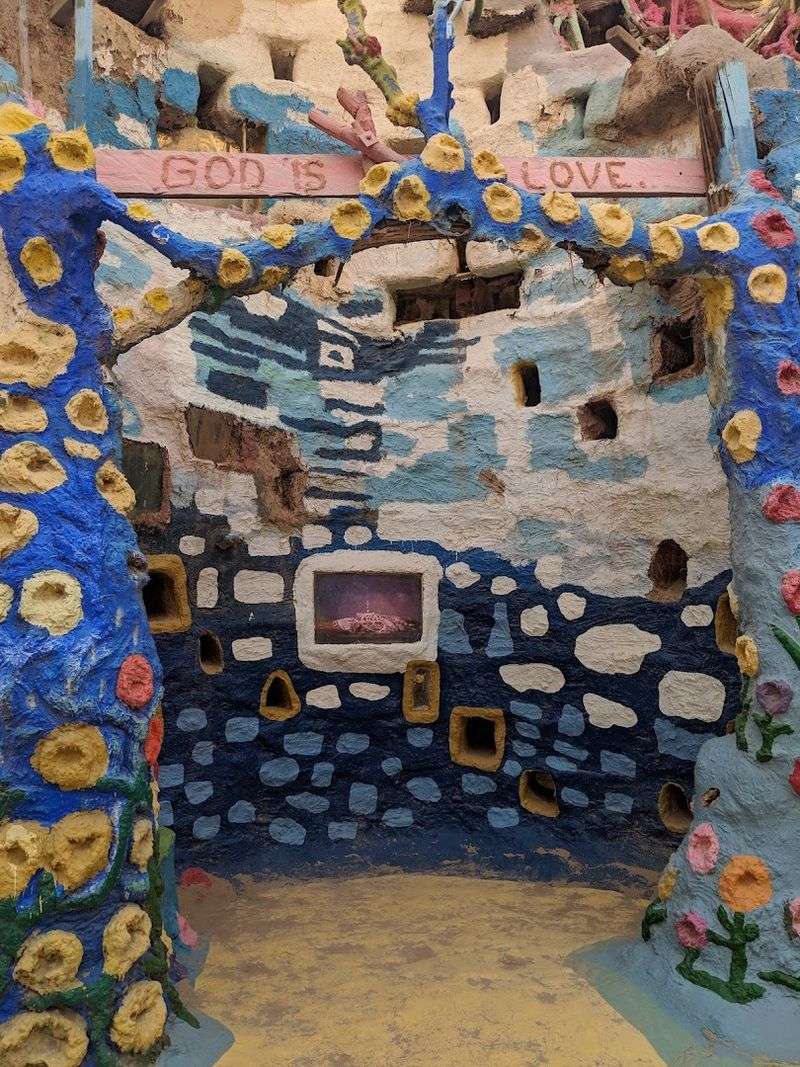
Just when I thought Salvation Mountain had already blown my mind completely, I discovered the caves tucked into the base of the mountain and realized the adventure had only just begun.
These hand-dug, hand-painted rooms wind through the interior of the structure like a psychedelic rabbit warren, supported by old tree trunks and telephone poles that Leonard collected and incorporated into the architecture over the years. Every surface is painted in the same wild, joyful style as the exterior, with messages of love and faith covering every inch of every wall.
Crawling through the low doorways and wandering from room to room felt genuinely otherworldly, like visiting a cathedral built by someone who had never seen a cathedral but had a very clear vision of what devotion should look like.
The painted flowers continue inside, climbing up the support poles and spreading across the ceilings in bursts of color that somehow manage to feel cozy rather than chaotic. Old paint cans, brushes, and tools are preserved throughout, giving you a sense of the ongoing labor that went into creating this place.
The caves are not huge, and some of the passages are a bit narrow, so if you are not a fan of tight spaces you might want to peek in from the doorway and appreciate the artistry from a comfortable distance.
But honestly, squeezing through those painted tunnels was one of the most memorable five minutes of my entire California road trip.
A Visual Feast That Hits Differently In The Desert
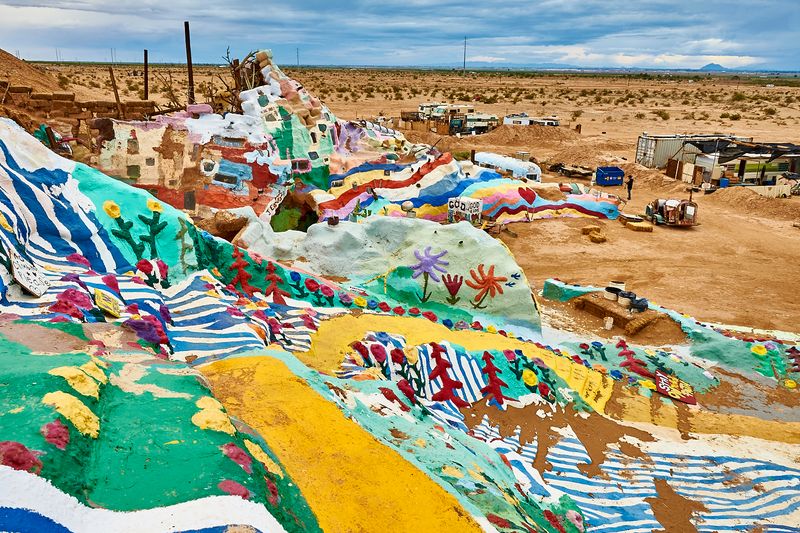
There is something about seeing intense, saturated color in the middle of a beige and brown desert landscape that does something profound to your brain chemistry. The colors here are not subtle or sophisticated in the art school sense, they are bold, unapologetic, and almost aggressively cheerful, and somehow that is exactly what they need to be.
Leonard Knight reportedly used thousands of gallons of donated paint over the decades, layering colors on top of colors until the surface became almost geological in its richness.
Up close, you can see the texture of the paint, thick and layered and cracked in places, revealing glimpses of older colors underneath like a geological cross-section of joy. The reds are the deepest and most dramatic, forming rivers and waterfalls that cascade down the slopes between fields of yellow flowers and blue skies.
White letters spell out messages against all of this color, standing out with a clarity that makes them feel almost illuminated even in flat midday light.
I spent an embarrassing amount of time just photographing details, a single flower here, a painted sun there, a curving river of red disappearing around a corner.
Every angle reveals something new, and the colors shift and warm as the sun moves across the sky, meaning the mountain you see at nine in the morning is a genuinely different visual experience from the mountain you see at four in the afternoon. Color has never felt so intentional.
Love Is The Point, Full Stop
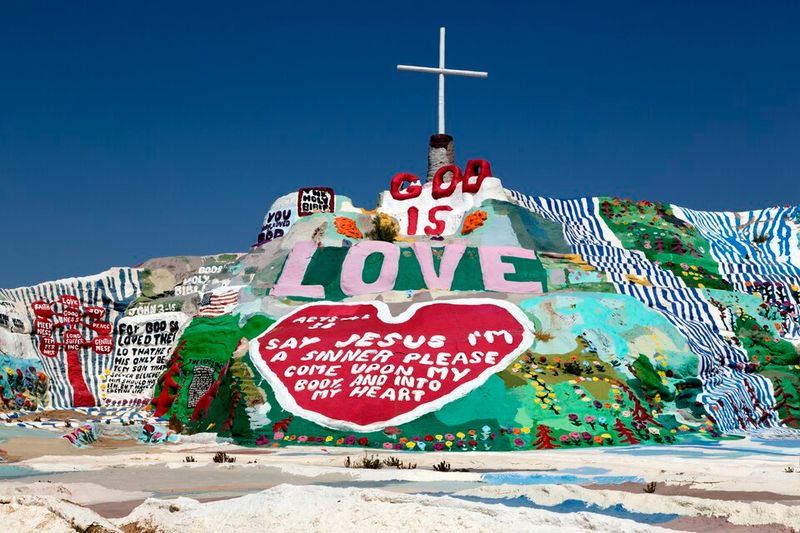
Salvation Mountain wears its heart on its sleeve, or more accurately, painted across every available surface in letters you can read from a hundred yards away. The central message is simple: God Is Love.
That phrase appears again and again throughout the site, in different sizes and colors and orientations, repeated with the kind of earnest conviction that makes you feel something even if organized religion has never been your particular path. There is something universally moving about witnessing that level of wholehearted commitment to a single idea.
Leonard Knight was not a trained artist or a theologian or a professional anything, really. He was a man with a message and an almost supernatural amount of perseverance, and the result is a place that communicates something genuine regardless of your personal beliefs.
Visitors from every background wander through Salvation Mountain and almost universally describe the same experience: an unexpected emotional response, a feeling of warmth and welcome, a sense that something real and human was poured into every painted inch of this strange and beautiful place.
Reading the messages painted across the slopes feels less like reading religious text and more like receiving a letter from someone who genuinely wanted you to feel okay.
In a world that can feel overwhelming and complicated on the best of days, that simple, painted insistence on love as the bottom line is more refreshing than you might expect. Sometimes the most powerful art is also the most straightforward.
Photography Paradise
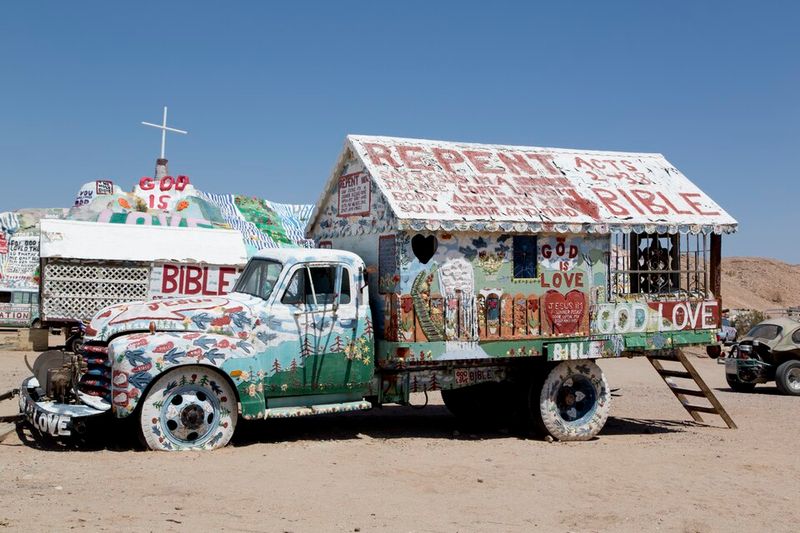
If your camera roll is looking a little uninspired lately, this place will fix that problem so fast your phone will need a storage upgrade before you leave the parking area.
Every single angle, every distance, every time of day produces a completely different and equally stunning image, and I say that as someone who spent three hours there and took approximately four hundred photos without once feeling like I was repeating myself.
The mountain is essentially a gift to anyone who loves visual storytelling.
The wide establishing shot from across the road gives you the full scale of the thing against the flat desert and big sky, which is the kind of image that makes people stop scrolling when they see it on social media.
Get closer and the textures of the layered paint and adobe clay become the subject, abstract and rich and endlessly interesting. Climb to the top and turn around for a view that combines the painted surface in the foreground with the Salton Sea shimmering in the distance, and you have a shot that looks completely impossible.
Golden hour here is something else entirely. The warm light picks up every texture and makes the colors glow in ways that feel almost supernatural, and the long shadows add drama and depth to surfaces that read as flat in harsh midday sun.
I watched the sun get low and the whole mountain transformed into something even more extraordinary than it already was, which I honestly did not think was possible.
This Place Stays With You Long After You Leave
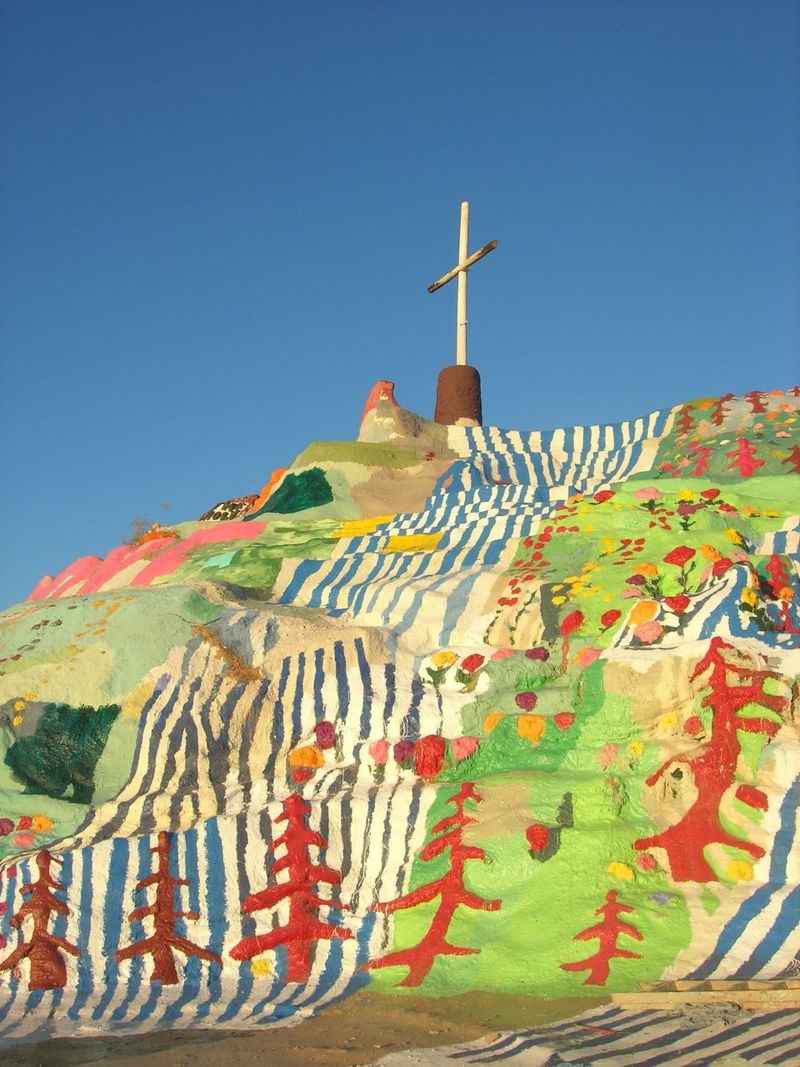
Some places you visit, enjoy, and then file away in the general category of nice experiences. Salvation Mountain is not one of those places.
I drove away from Niland with my windows down and the desert wind coming in warm and dry, and I could not stop thinking about what I had just seen for the entire two-hour drive home.
There is something about a place built entirely on the back of one person’s belief and stubbornness and joy that gets under your skin in a way that polished tourist attractions simply cannot replicate.
The thing that struck me most, looking back, was not the scale or the colors or even the artistry, though all of those things are genuinely remarkable.
It was the feeling that someone had stood in the middle of an empty desert and decided to build something beautiful anyway, without permission or funding or any guarantee that anyone would ever come to see it.
That kind of commitment to a vision is rare and moving and a little bit humbling when you think about it honestly.
Salvation Mountain reminds you that art does not require credentials, that devotion does not require an audience, and that sometimes the most extraordinary things in the world are built by ordinary people who simply refused to stop.
If you have been looking for a reason to take that desert road trip you keep putting off, this painted mountain in the California desert is reason enough.
Have you ever stood in front of something and felt your whole understanding of what is possible shift just a little?