
This Wonderfully Weird Roadside Attraction In Florida Will Make You Do A Double Take
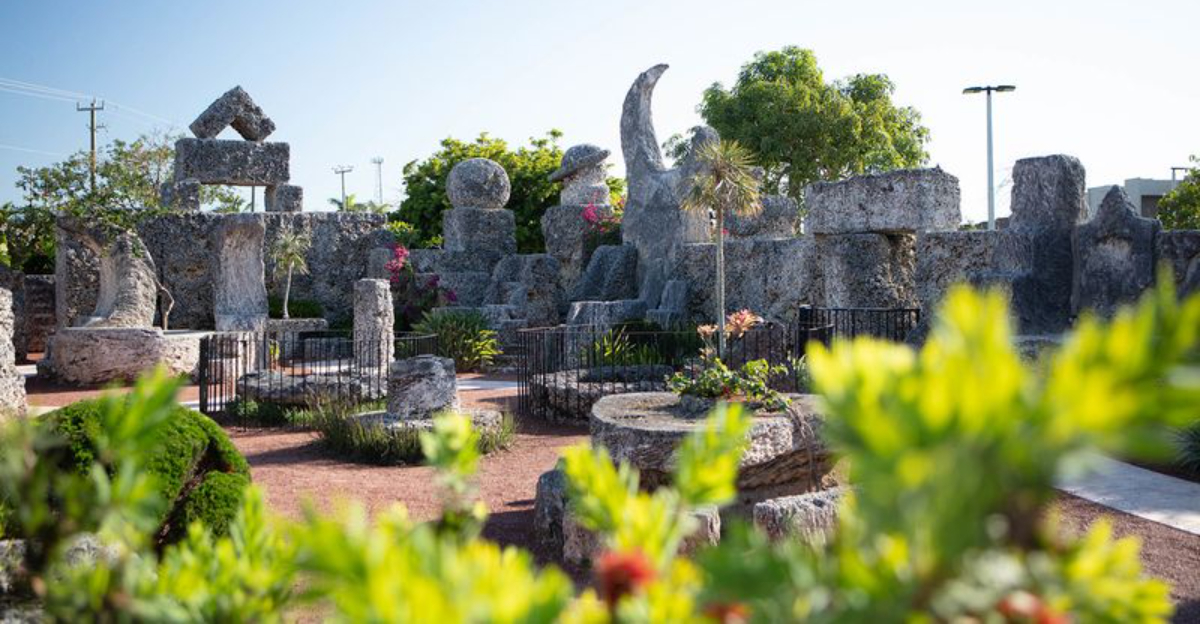
There’s a place in South Florida that still makes people scratch their heads. It’s called Coral Castle, and a man named Edward Leedskalnin spent almost three decades building it completely by himself.
He carved and moved more than a thousand tons of coral rock using tools no one ever really saw him use. The result looks like a mix of furniture, gates, and towers all made out of stone.
Locals in Homestead still talk about how he pulled it off, and when you see it in person, you can’t help but wonder the same thing.
Built By One Man Over Decades
Edward Leedskalnin carved and assembled roughly 1,100 short tons of oolitic limestone into walls, furniture, and towers, working largely in secret. He stood just five feet tall and weighed around a hundred pounds, yet he moved blocks weighing several tons each.
Most of his work happened at night, and he refused to let anyone watch. Neighbors reported hearing scraping and tapping sounds long after dark.
When I walked through the courtyard for the first time, I kept thinking about how he did this without a crew or heavy equipment. The sheer scale of it makes you question what one determined person can accomplish.
Precision Stonework With No Mortar
Blocks are fitted so tightly that light barely passes through the joints, and most pieces were carved from single stones. Each joint looks almost seamless, as if the rock grew together naturally.
Modern masons study these connections because the technique is so clean. No cement or glue holds the walls in place, just gravity and perfect angles.
Running your hand along the seams, you can feel how smooth the edges are. It is hard to believe someone did this with hand tools and patience alone.
The Famous Nine-Ton Gate
A massive swinging stone door once rotated with a fingertip after being perfectly balanced on bearings, a long-standing engineering curiosity. The gate stood eight feet tall and weighed over 18,000 pounds, yet it moved as smoothly as a kitchen cabinet.
In the 1980s the gate stopped working, and a crew with a crane had to remove it to find the problem. They discovered a truck bearing at the center, placed so precisely that the whole stone pivoted without effort.
Seeing it in person, even though it no longer swings, you understand why engineers traveled here just to study one door.
Stargazer Touches
On site you will find an accurate sundial and a polar Polaris telescope, part of a larger set of celestial motifs carved in stone. Leedskalnin was fascinated by astronomy and built several instruments to track the sun and stars.
The sundial tells time within a few minutes, even today. The Polaris scope is just a hole drilled through rock, but it lines up perfectly with the North Star.
Standing next to the sundial on a clear afternoon, I checked my watch and saw it matched almost exactly. It is a reminder that ancient methods still work if you understand the sky.
Folklore Versus Physics
Legends credit magnetism or mystery methods, but evidence points to clever use of pulleys, tripods, and simple machines. Some visitors insist Leedskalnin knew secrets about gravity or energy that science has forgotten.
Researchers who have studied the site say he likely used block and tackle rigs, wooden levers, and counterweights. Tools found on the property support this theory, though no one watched him work.
The truth is probably less magical than the stories, but it is still impressive. Simple tools and patience can move mountains if you know what you are doing.
On The National Register
The property, originally called Rock Gate, was listed on the U.S. National Register of Historic Places in 1984. This designation recognizes the site as an important piece of American folk architecture and engineering.
Being on the register means the castle receives some protection and funding for preservation. It also draws historians and students who want to study unconventional building methods.
When I visited, a school group was sketching the stone chairs and asking their teacher how one man did all this. It is good to see young people curious about history they can touch and walk through.
Pop-Culture Footprint
Billy Idol’s song Sweet Sixteen was inspired by the Coral Castle love story, and the site has appeared in films and TV. Leedskalnin built the entire structure for a woman who left him before their wedding, a tale that has fueled songs, documentaries, and novels.
The music video for Sweet Sixteen was filmed partly at the castle. Television shows about mysteries and engineering often feature it as an unsolved puzzle.
Even if you are not a Billy Idol fan, the love story adds a layer of sadness and determination to the stone walls. Heartbreak can build something lasting.
Photo And Timing Tip
Arrive early or near golden hour. Low-angle light throws sharp shadows that make the Florida-shaped table, heart table, and carved planets pop in photos.
Midday sun flattens everything and washes out detail, but morning or late afternoon light carves texture back into the stone. The heart-shaped table looks especially good when shadows fill the carved lines.
I showed up around 4 p.m. on a winter afternoon, and the light made every chisel mark stand out. Bring a camera and take your time, because the place looks different depending on where the sun sits.