
You’ll Want To Visit This Haunting Forgotten Mausoleum Hiding In Washington
I did not expect a quiet Washington island to make me feel like I had stepped into the last page of someone else’s story. One minute, the path feels peaceful and green, the kind of place where trees do most of the talking.
Then the stone circle appears, weathered, solemn, and oddly magnetic, sitting there like a secret the forest has been keeping politely.
I slowed down without meaning to. Maybe it was the symmetry, maybe the moss, or maybe the strange feeling that this place was built as much for questions as remembrance. It is not flashy, and that is exactly why it stays with you.
Some places ask for attention. This one waits, quiet and eerie, until curiosity pulls you closer.
Who Was John S. McMillin
Few people build their own legacy in stone quite as literally as John Sheafe McMillin did. Born in 1855, McMillin was a sharp-minded businessman who transformed a rocky corner of San Juan Island into one of the most productive lime operations in the American West.
His Roche Harbor Lime Company dominated the regional industry for decades, making him a wealthy and influential figure throughout Washington State.
Beyond business, McMillin was deeply devoted to his Methodist faith and the Masonic Order, both of which would heavily shape the design of his memorial. He was known for running Roche Harbor almost like a private town, with workers living on company property under his watchful management.
When he passed in 1936 at the age of 81, he left behind not just a business empire but a mausoleum so unusual and symbolically rich that people still make the trip specifically to understand the man who dreamed it up.
Finding Afterglow Vista
Getting to the mausoleum is part of what makes the experience so memorable. You start at the historic Roche Harbor Cemetery, where helpful signs point you toward the trailhead.
The path itself is wide and easy to walk, cutting through a dense stand of Pacific Northwest evergreens that muffle sound and shift the light into something soft and green.
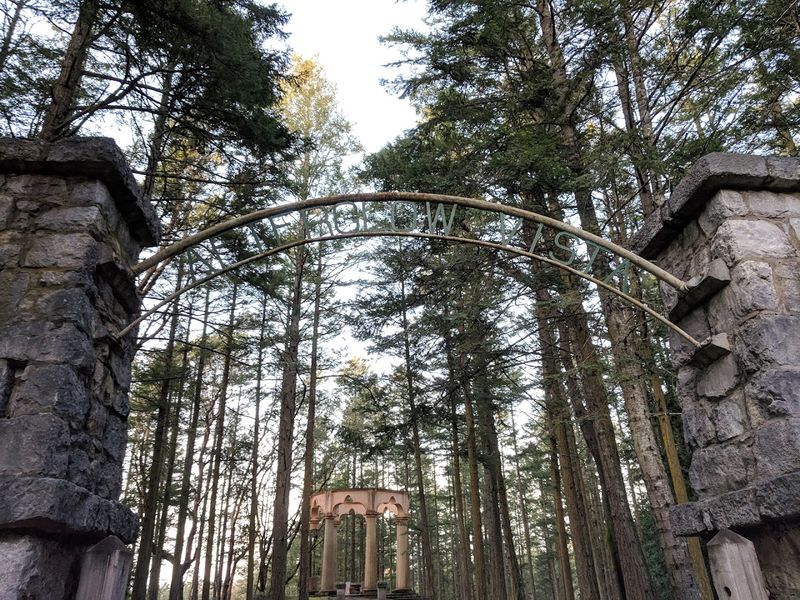
After just a short walk, you arrive at a set of iron gates bearing the words “Afterglow Vista” across the top. Passing through them feels like crossing a threshold into a completely different atmosphere. The trees press in close, the air cools noticeably, and the sounds of the harbor disappear entirely.
Families with young children, casual walkers, and history enthusiasts all manage this trail without any difficulty.
It is one of those rare cases where the journey genuinely builds anticipation for the destination, and the payoff at the end of the path absolutely delivers on every bit of that quiet woodland promise.
The Open-Air Rotunda
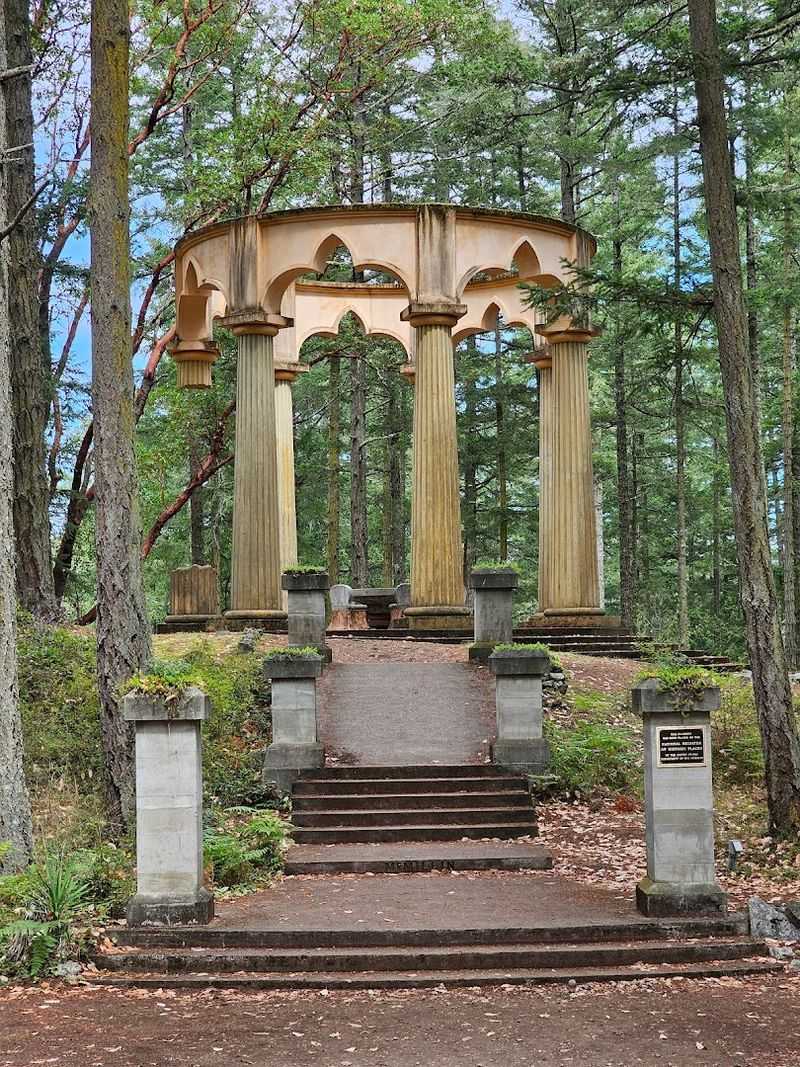
The first full view of the mausoleum hits you like a scene from a movie set. It is an open-air rotunda built from limestone and concrete, combining neoclassical design with deeply personal Masonic symbolism in a way that feels both grand and intimate at the same time.
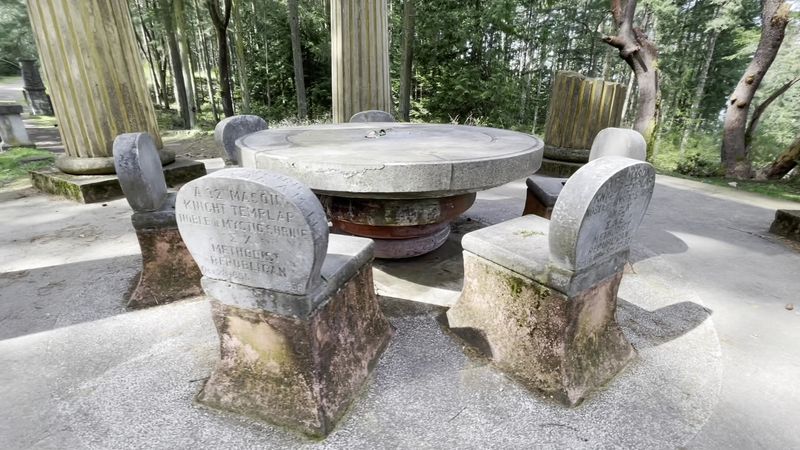
There is no roof, just sky, and that openness gives the whole structure a raw, elemental quality. Seven fluted Tuscan columns rise from the circular platform, framing a round central table surrounded by six concrete chairs.
The columns were deliberately designed to match the dimensions of those in King Solomon’s Temple, a detail that speaks directly to McMillin’s Masonic beliefs and his desire to anchor the structure in something larger than himself.
What strikes most visitors immediately is how the structure manages to feel both ceremonial and deeply personal. It is not a cold monument built for public display. It reads more like a private dining room frozen in stone, waiting patiently for a gathering that will never quite come.
The Family Gathered For Eternity
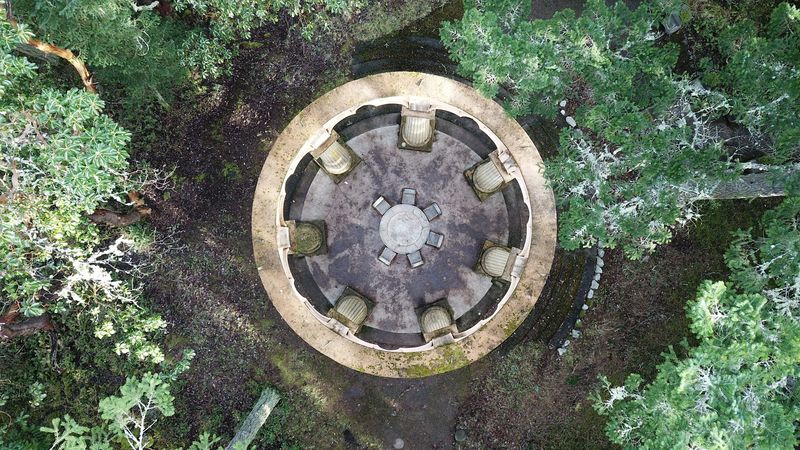
One of the most quietly unsettling and genuinely moving details of Afterglow Vista is that the chairs around the central table are not decorative.
Each one is a crypt containing the cremated remains of a family member, with names carved directly into the backrests. John S. McMillin and his wife sit at the head, with three children and his personal secretary completing the circle.
The idea was unmistakably intentional: McMillin wanted his family united around a table in the afterlife just as they had gathered in life. It is a concept that feels almost tender when you consider it carefully, a man so attached to the idea of family togetherness that he literally built it into stone.
Standing among the chairs and reading each name makes the place feel suddenly very human. These are not abstract historical figures on a plaque.
They are people who once sat at real tables, shared real meals, and now rest in a clearing in the Washington woods together, forever.
The Broken Column
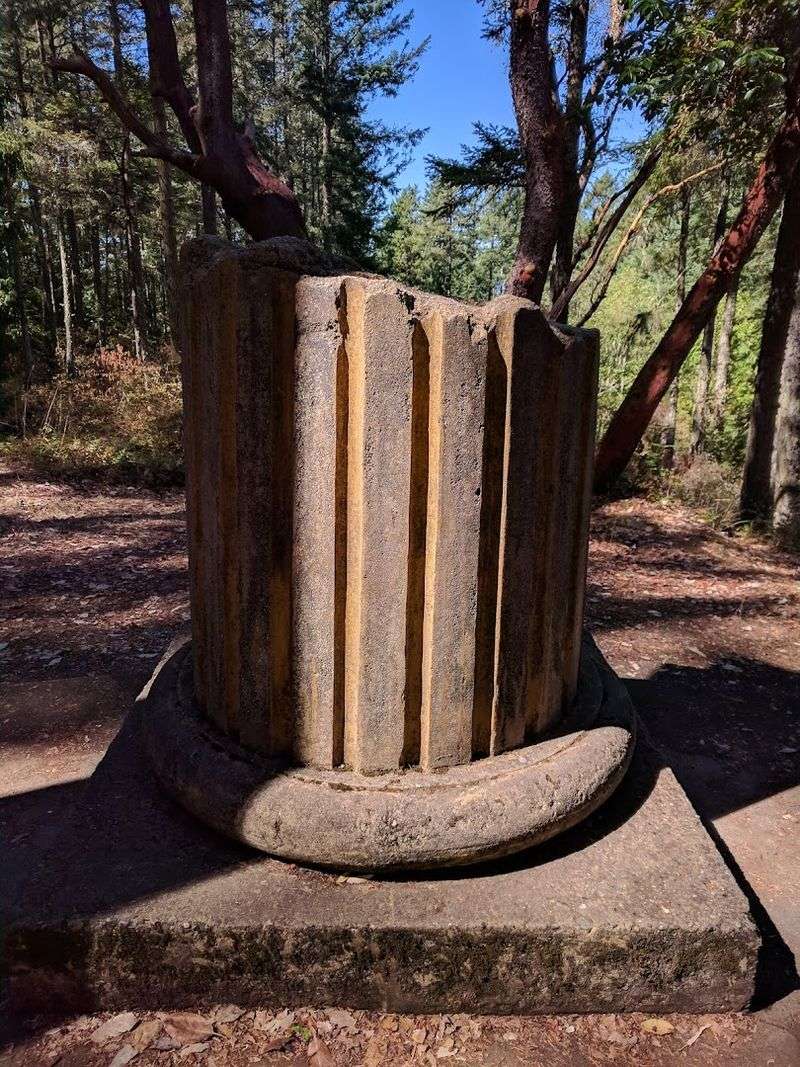
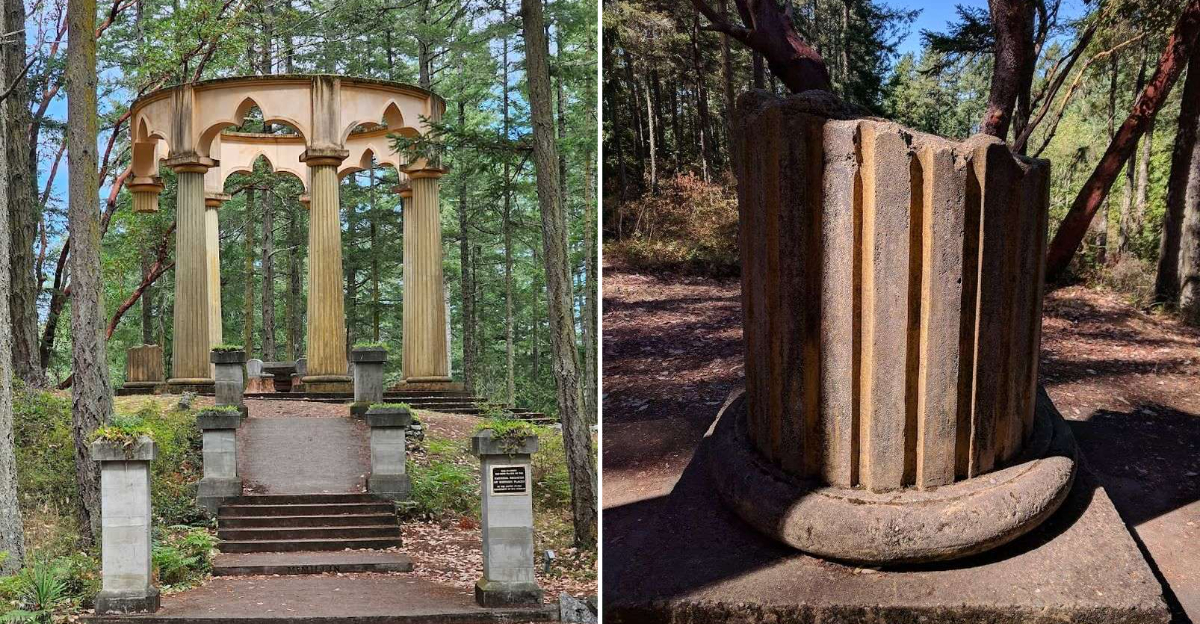
Among the seven Tuscan columns that ring the rotunda, one stands out immediately because it does not stand at all, at least not completely. One column is intentionally broken, its top cut away and left unfinished. Far from being a flaw, this was a deliberate design choice rooted in Masonic tradition.
The broken column represents what Masons call the broken column of any man’s life, a symbol of unfinished work and the universal truth that no human project is ever truly complete.
It is a strikingly honest statement to embed into your own memorial, an acknowledgment that even a man as driven and accomplished as McMillin left things undone.
Visitors often spend extra time at this column, photographing it and puzzling over its meaning. Once you understand the symbolism, it shifts the entire mood of the site.
What might look like damage or neglect is actually one of the most thoughtful and philosophically rich design choices in the whole remarkable structure, and it rewards a second look.
Every Detail Has A Meaning
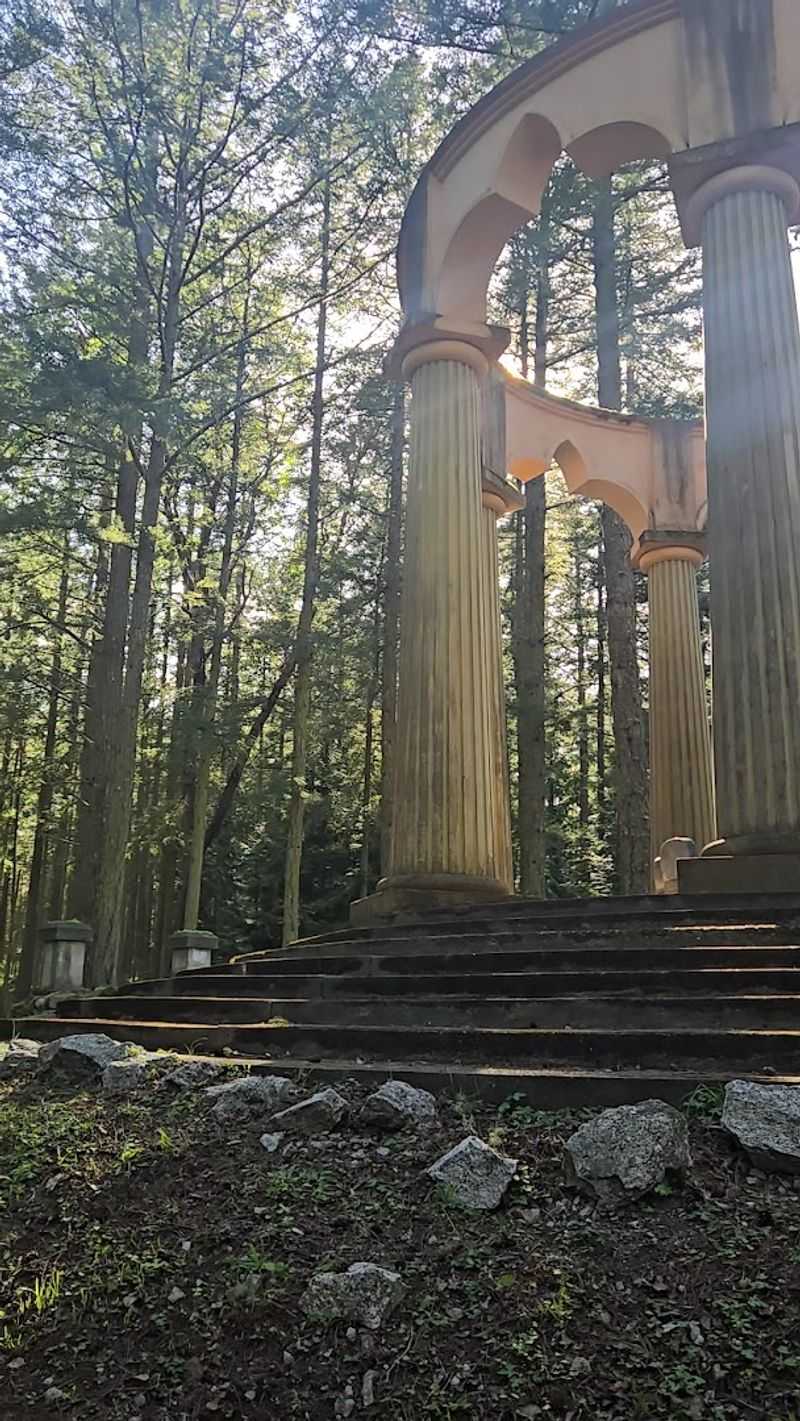
Most people climb the stairs to the mausoleum without realizing they are walking through an encoded message. The steps leading up to the rotunda are arranged in sets of three, five, and seven, a sequence that is anything but random.
Each grouping carries specific Masonic significance that McMillin wove into the very approach to his resting place.
The three steps represent the three stages of life: youth, adulthood, and age. The five steps refer to the five classical orders of architecture. The seven steps honor the seven liberal arts, which in the Masonic tradition include grammar, rhetoric, logic, arithmetic, geometry, music, and astronomy.
Knowing this before you visit turns a simple walk up a staircase into something closer to reading a text. McMillin essentially wrote his beliefs in stone, making sure that anyone who paid attention would encounter his philosophy with every footfall.
It is the kind of layered detail that rewards curious visitors who take their time and resist the urge to rush past.
The Empty Chair
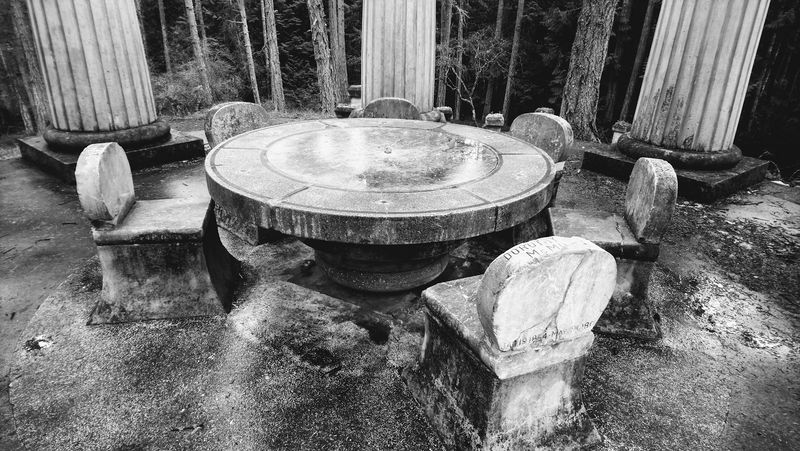
Look carefully at the chairs around the table and you will notice that one space appears unoccupied. Local lore holds that this empty seat represents a McMillin son who broke from the family’s strict Methodist faith, and as a result was excluded from the family’s eternal gathering.
Family tensions, religious expectations, and the weight of a patriarch’s disappointment, all of it seemingly cast in concrete and left out in the open for strangers to contemplate. It is a remarkably candid window into the private life of a man who otherwise projected wealth and authority.
That empty chair tends to linger in visitors’ minds long after they leave the clearing. It transforms the mausoleum from a monument of pride into something more complicated and more human, a reminder that even the most carefully planned legacies carry the unresolved stories of real family life inside them.
Nature Meets Design
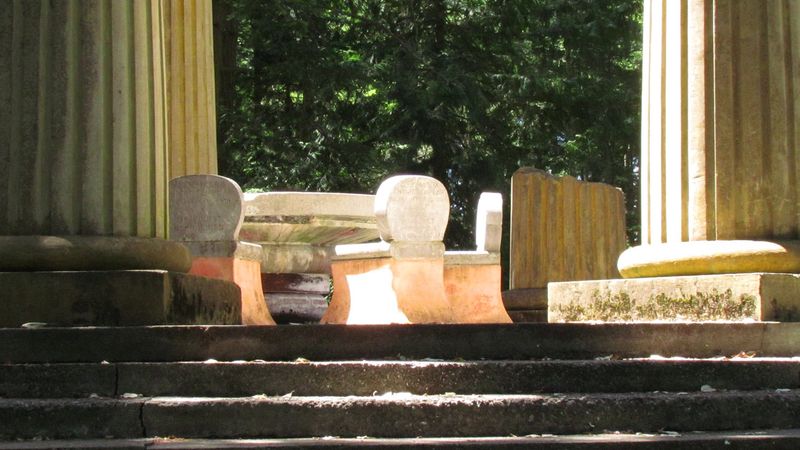
Here is a detail that moves Afterglow Vista from impressive to genuinely extraordinary. The entire mausoleum was deliberately oriented so that during June, the setting sun aligns perfectly with the broken column.
As the light falls through that intentional gap, it travels across the rotunda and lands directly on the crypts of John S. McMillin and his wife.
This kind of solar alignment requires serious planning and precision. McMillin and whoever designed the structure with him clearly wanted the natural world to participate in the memorial in a meaningful way.
It turns the summer solstice into something close to a private ceremony, one that plays out whether anyone is watching or not.
Visiting in June specifically to witness this alignment has become a quiet tradition for some San Juan Island regulars. If your travel schedule allows for it, timing your visit to catch this moment is absolutely worth the effort.
Watching sunlight find its mark across a stone table in a forest clearing is the kind of thing you do not easily forget.
Planning Your Visit To Roche Harbor And Afterglow Vista
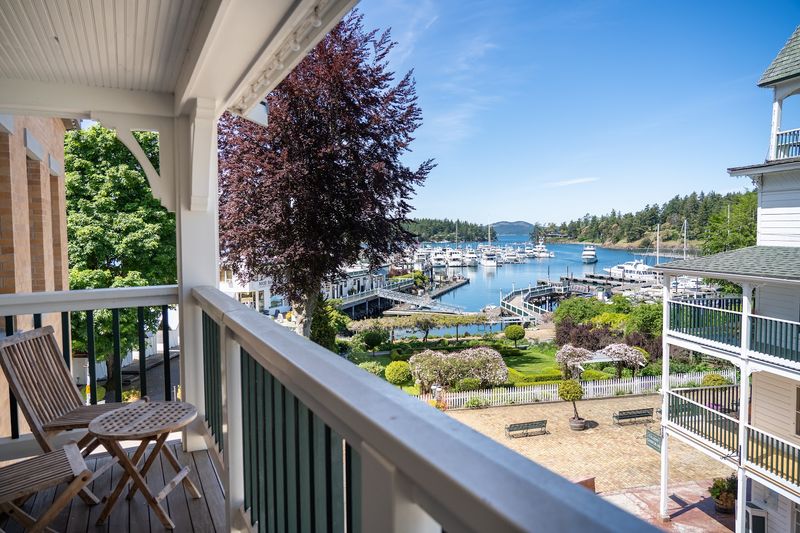
Roche Harbor sits at the northern tip of San Juan Island, Washington, and reaching the island itself is a straightforward adventure by Washington State Ferry from Anacortes.
4The ferry ride offers sweeping views of the San Juan archipelago that set the tone for the whole trip. Once on the island, Roche Harbor is roughly 10 miles from Friday Harbor and well worth the short drive.
The mausoleum is free to visit and accessible during daylight hours. The trailhead begins at the Roche Harbor Cemetery, located near the Roche Harbor Resort at 248 Reuben Memorial Drive, Roche Harbor, WA 98250.
Parking is available at the resort, and the staff there can point you in the right direction if the signs are not immediately obvious.
Wear comfortable shoes for the trail and bring a camera, because every angle of this place rewards a photograph. The resort itself offers lodging, dining, and a marina, making it easy to build a full Pacific Northwest weekend around this singular, unforgettable stop in the San Juan Islands.