
This Illinois Covered Bridge Was One Of The Last You Could Drive Across
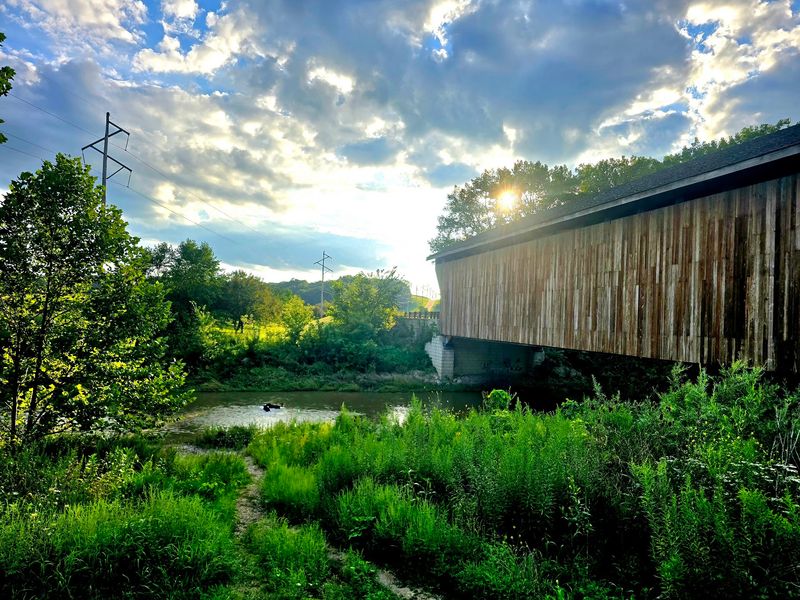
Tucked into the farmland of Bureau County, Princeton’s Red Covered Bridge spent more than 150 years carrying real traffic across Big Bureau Creek – a working piece of American history that most states lost long ago. Before November 2023, it held the rare distinction of being Illinois’ only state-owned covered bridge still open to vehicles, meaning ordinary drivers could roll right through a mid-19th-century timber tunnel on a regular country road.
Then an oversized truck struck the structure and changed everything. The bridge is currently closed, repairs are in progress, and anyone planning a visit needs accurate information before heading out.
A Former Drive-Through Landmark Near Princeton
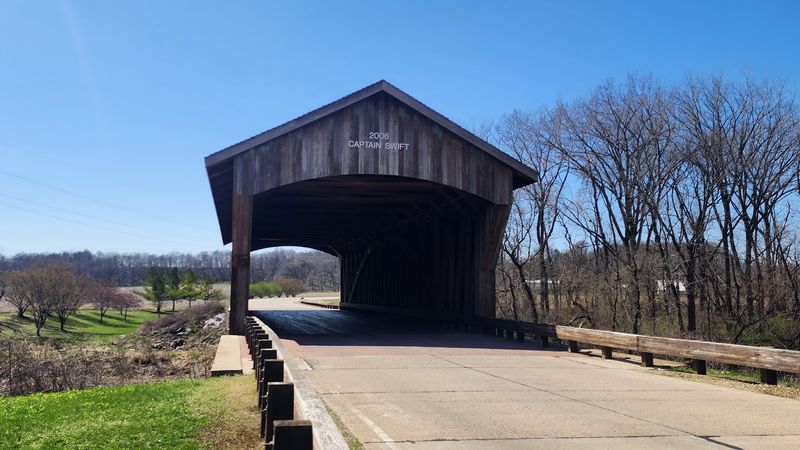
Princeton’s Red Covered Bridge sits about a mile north of the city, roughly half a mile west of Illinois Route 26, on a stretch of Old Dad Joe Trail where the road crosses Big Bureau Creek. That address sounds simple enough, but what made this spot genuinely unusual was what drivers encountered there: a full-scale, one-lane covered bridge that was not a museum piece or a walking path but an active, state-maintained road crossing.
Until late 2023, you could legally drive your car through it.
The article title that brought you here needs a correction right away. The Red Covered Bridge is not currently open to vehicles.
IDOT described it as the only state-owned covered bridge open to traffic in Illinois – a distinction it held right up until a damaging truck collision in November 2023 forced an indefinite closure. That closure remains in effect according to the latest official information reviewed through August 14, 2026.
This article covers the bridge as a historical roadside stop and a potential future destination, not as an available drive-through attraction. Readers planning a trip need to understand what the site currently offers, what it does not, and how to check official sources before setting out.
The history here is real and worth knowing. The access restrictions are equally real and equally worth knowing before you load up the car.
A Mid-Nineteenth-Century Timber-Truss Bridge

Construction on the Red Covered Bridge began in 1863, and IDOT records show it was completed in 1864. Writers and visitors sometimes cite one year or the other, but the safest description is that this is a mid-19th-century bridge, built during the Civil War era and finished just as the war was ending.
Either way, the structure has been standing over Big Bureau Creek for well over 160 years, which puts it in a category of infrastructure that very few American communities have managed to keep.
Physically, the bridge is a one-lane timber-truss design. The covered form – that wooden roof and enclosed sides – is not decorative.
Covered bridges were built that way because the enclosure protected the load-bearing timber trusses from rain, snow, and sun, dramatically extending the life of the wood. An open wooden bridge might last a few decades; a well-maintained covered bridge could survive a century or more.
The Red Covered Bridge is proof of that principle.
IDOT’s closure announcement confirms that the bridge was listed on the National Register of Historic Places in 1975, with engineering, transportation, and architecture all identified as areas of significance. That three-part designation is telling.
The bridge matters not just because it looks like a postcard from another century, but because it represents how roads were actually built and how goods and people actually moved through central Illinois before steel and concrete became the standard. The National Park Service asset record also documents its historical significance as a surviving example of this once-common construction method.
Why Its Former Vehicle Access Was Unusual
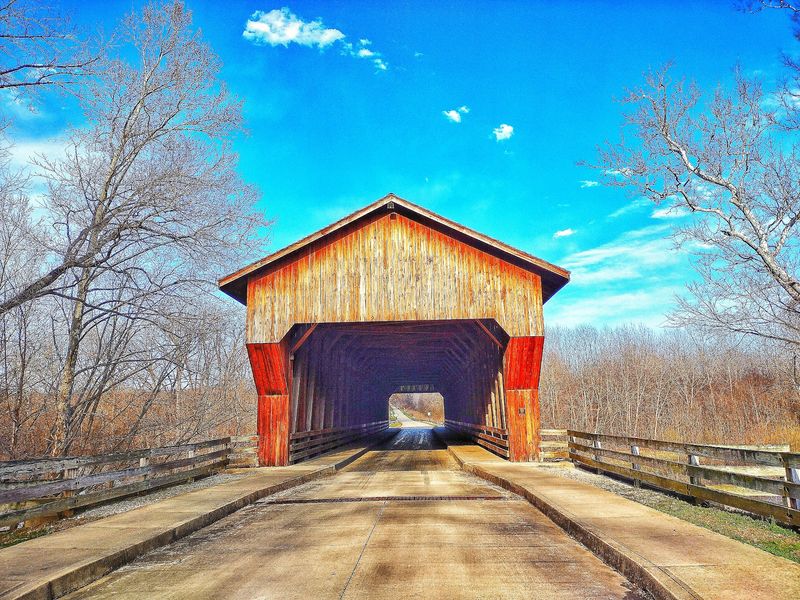
Most covered bridges that survive into the 21st century have been retired from vehicle traffic. They sit alongside modern replacements, fenced off or gated, preserved as scenic landmarks while actual cars use a concrete span nearby.
The Red Covered Bridge worked differently. Right up until November 2023, it was the road.
Drivers on Old Dad Joe Trail used it to cross Big Bureau Creek the same way drivers had been doing for generations.
IDOT reported that the bridge carried an average of about 275 vehicles per day before the closure, and the agency described it as the only state-owned covered bridge in Illinois still open to traffic. That specific wording matters.
IDOT was not claiming it was the last drivable covered bridge in the Midwest or in America – a much broader claim that the available records do not support. The distinction they drew was narrower: among bridges owned and maintained by the state of Illinois, this was the one still carrying cars.
That narrower distinction is still remarkable. Maintaining a mid-19th-century wooden structure as a functioning road crossing requires ongoing investment, careful weight limits, and a willingness to keep an old thing alive when replacing it with something modern would be far simpler.
For drivers who happened to use it, the experience was genuinely unusual – a brief passage through a wooden tunnel that connected daily life to a construction method from the 1860s. Those 275 daily crossings were not tourists seeking a novelty.
They were commuters and locals for whom this covered bridge was simply the bridge on their route.
The 2023 Truck Strike Closed the Crossing
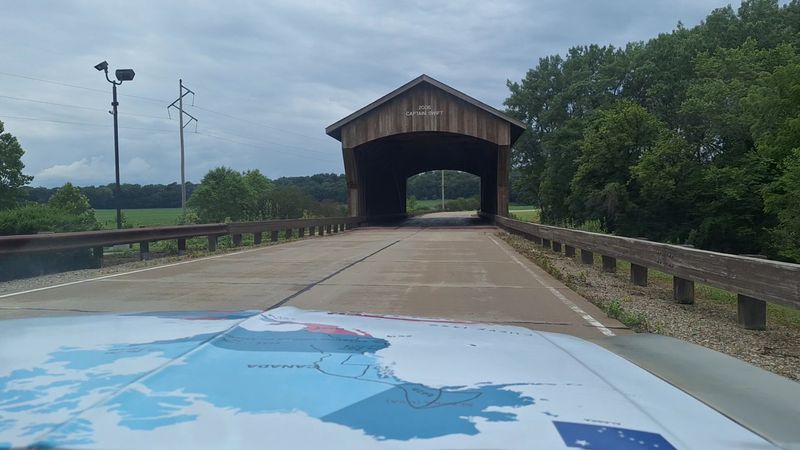
On November 16, 2023, an oversized truck struck the Red Covered Bridge and ended its run as an active vehicle crossing. The collision caused extensive damage to the historic structure – not the kind of wear that accumulates slowly over decades, but sudden, concentrated impact damage to a building that had survived since the Civil War era.
IDOT closed the bridge to traffic immediately and began assessing the full extent of the damage before committing to a repair approach.
The closure was not a routine maintenance decision or the natural end of a structure that had simply aged out. The bridge had been carrying about 275 vehicles a day and was actively maintained by the state.
What changed was a single event: a vehicle that exceeded the bridge’s 10-foot-11-inch height clearance passed through and caused structural harm that could not be driven around or patched quickly. The bridge that had outlasted wars, floods, and more than a century and a half of Illinois winters was taken down not by time but by one bad decision behind the wheel of an oversized rig.
As IDOT moved the bridge into its rehabilitation planning phase, the agency installed temporary bracing to stabilize the structure while engineers worked out what would need to be replaced. The damage affected the roof, framing, siding, and truss components – essentially the elements that define a covered bridge’s form and function.
Barricades went up at both ends, and the crossing that had served Bureau County drivers for generations became a closed historic structure awaiting a repair process that is still working through official channels as of the latest records reviewed.
What the Listed Repair Project Does—and Does Not—Promise
IDOT’s documented repair scope is substantial. Plans call for replacing the roof, roof cross-bracing, floor beams, siding, and damaged truss components – essentially rebuilding the parts of the bridge that define both its structural integrity and its historic character.
The agency has also discussed adding height-detection equipment and more visible warning signs at the approaches, addressing the gap in safeguards that allowed an oversized truck to reach the structure in the first place. The stated clearance height is 10 feet 11 inches, and better advance warning at that threshold is part of the proposed solution.
IDOT’s safety update blog post describes the intent to restore the bridge to its original condition, which signals a preservation-focused approach rather than a replacement with modern materials. That matters for anyone who cares about the bridge’s historical character.
A restored timber-truss covered bridge is a different thing from a steel substitute wearing a wooden facade.
What the paperwork does not provide is a firm reopening date or confirmation that on-site construction work has started. IDOT’s July 31, 2026 letting summary lists the repair project with a 60-working-day contract period.
That figure describes how long the awarded contract gives the contractor to complete the work, not a countdown to a public reopening. The letting summary does not confirm that crews are currently on site, and no reviewed document establishes a date when the bridge will be open to vehicles again.
Travelers should treat the repair as a planned and formally listed project, not as a construction process with a known finish line.
If Access Is Permitted, View the Entrance Area Only
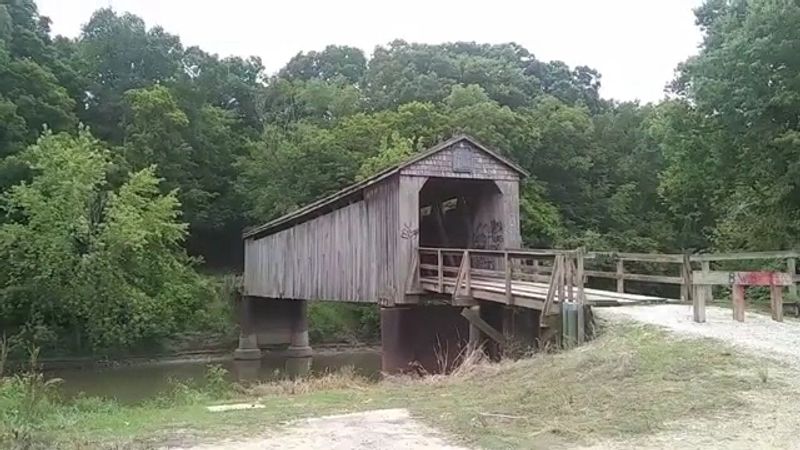
Visiting the Red Covered Bridge right now requires a clear-eyed understanding of what the site offers. Barricades block the road at the bridge entrance, preventing vehicles from continuing across.
Those barriers are not suggestions. Moving them, driving around them, or treating them as an obstacle rather than an official closure order is unsafe and potentially illegal.
The bridge has sustained serious structural damage, and no official source reviewed for this article authorizes public entry into the structure or pedestrian crossing.
IDOT’s rehabilitation update makes clear that the bridge remains off-limits to traffic while repair work is planned and carried out. Visitors may be able to reach the entrance area and view the exterior of the bridge from the road approach, but only if current local access rules permit that kind of proximity.
That condition is not guaranteed. Construction activity, updated closure orders, or site security measures could restrict access further at any point during the repair project.
Before making a trip specifically to see the bridge, check IDOT’s traveler information resources and look for a current IDOT District 3 announcement. The Getting Around Illinois system tracks road closures in real time, and a quick check before departure can confirm whether the approach road is accessible or whether conditions have changed.
Treating the bridge as a scenic viewpoint from a respectful distance – rather than as an open attraction – is the responsible approach until officials announce otherwise.
Wait for IDOT to Confirm the Next Drive-Through
The Red Covered Bridge’s former vehicle access was a genuinely unusual thing – a mid-19th-century timber crossing that kept doing its job well into the 21st century, carrying about 275 cars a day across Big Bureau Creek until a single truck collision ended that run in November 2023. Whether that access returns depends on a repair process that, as of the latest records reviewed through August 14, 2026, has been formally listed but not confirmed as complete or reopened.
Travelers sometimes ask about Little Mary’s River Covered Bridge near Chester as an alternative covered-bridge experience. That bridge completed its own restoration and reopened in September 2025 as a pedestrian-only crossing, not a vehicle route.
It is worth a visit on its own terms, but it is not a substitute for the drive-through experience the Red Covered Bridge once offered.
The right approach for anyone drawn to the Red Covered Bridge is to bookmark it as a future road-trip stop rather than a current one. IDOT’s project updates are the place to watch for a confirmed reopening announcement.
When that announcement comes, the drive through a restored 160-year-old timber tunnel on a Bureau County back road will be worth the wait – because bridges like this one are not built anymore, and the ones that survive deserve to be treated with the patience they earned.